
JAMES MACMILLAN
Seven Last Words from the Cross (1993)
The Seven Last Words is a compilation from the four Gospels of the last phrases Jesus uttered during his crucifixion. They are not part of the canonical Good Friday liturgy, but they are used in the Stations of the Cross, often observed during Lent, and are popular material for homilies. Vocal and choral arrangements date back at least to the 16th century. Haydn was famously commissioned to provide orchestral meditations on that text for a Good Friday service, which he later reset variously for piano, string quartet, and eventually as an oratorio.
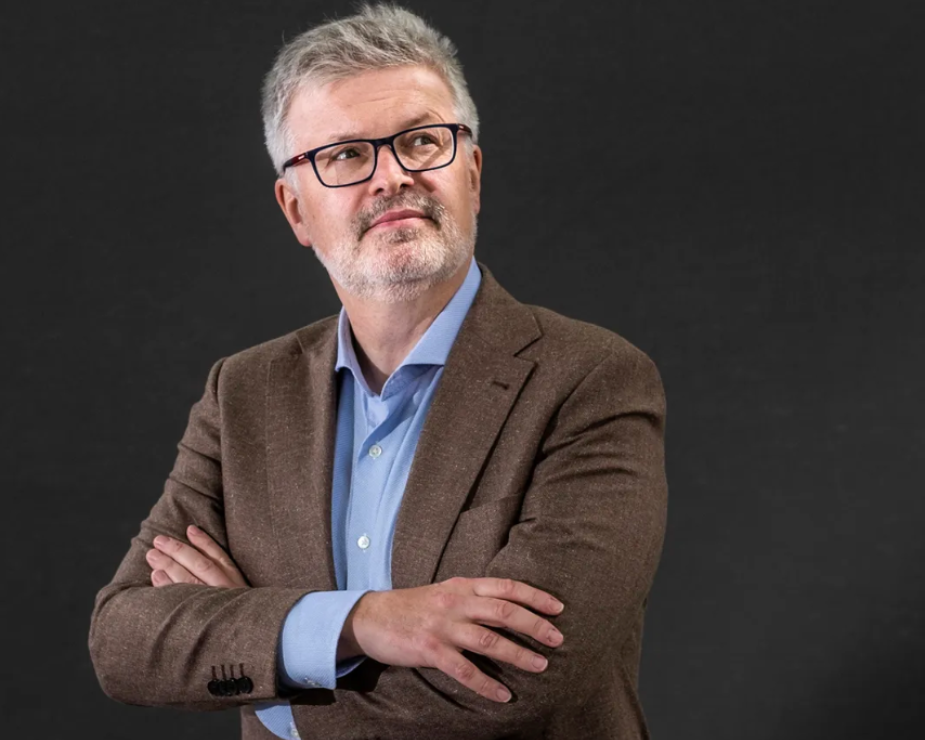
In 1993, BBC Television commissioned a setting to be performed in seven nightly episodes during Holy Week of 1994, and turned to Scottish composer James MacMillan. MacMillan received his B Mus degree in composition from the University of Edinburgh in 1981 and his PhD in composition from Durham University in 1987. He briefly served on the faculty of the Victoria University of Manchester before returning to Scotland and devoting himself to composition. He is a highly regarded and prolific composer of orchestral, chamber, theatrical and choral music with numerous prestigious commissions and awards. A Lay member of the Dominican Order since his undergraduate days, he is a committed and sometimes vocal Catholic, and his faith and sense of social justice inform many of his works. His music is often complex in structure, with multiple, often contrasting, layers of music. MacMillan may be best known for his sacred choral music, but he is even able to insert the sacred into his purely orchestral music, including his first percussion concerto
Veni, veni Emmanuel,
Symphony: Vigil and
Symphony No. 3: Silence. Musically, he is strongly influenced by traditional Scottish folk music and by the highly ornate music of the 16th century Scottish cleric and composer Robert Carver. MacMillan was knighted by Queen Elizabeth II in 2015, and King Charles III appointed him one of only sixteen Knights in the Order of the Thistle earlier this year.
While the BBC presented
Seven Last Words from the Cross episodically, MacMillan always considered the work as a unified piece and it was given its concert premiere in that format even before the broadcasts were completed. MacMillan supplements the
Seven Last Words text material from other sources including the Good Friday service, the Tenebrae service (an evening service often held on the Wednesday of Holy Week in which candles lighting the church are extinguished one by one after each reading, and concluding with a loud noise, signifying either the cataclysm following the death of Jesus or the closing of his tomb with a stone) and the Reproaches (a series of antiphons optionally chanted during the Good Friday veneration of the cross and set in the first person, Jesus recounting how the benevolence of God was answered with his suffering and death).
1. Father, forgive them, for they know not what they do
The first movement opens with a three-note motif in the orchestra like a sigh or soft moan. It forms an ostinato that supports the opening melody in which the soprano and alto voices enter sequentially. MacMillan borrows this motif from the end of his otherwise spiky and angular 1991 clarinet quintet
Tuireadh (Lament), where it is used in the same fashion, and it will become a unifying element in this work. MacMillan creates an additional musical layer with the addition of the divisi tenors and basses. The text is the exuberant welcome of Jesus to Jerusalem two days earlier, with the people shouting “Hosanna to the Son of David, the King of Israel,” as recounted in the Gospels of Mark and Luke. There is an irony to the text, since the same people who welcomed Jesus so effusively were calling for his execution just two days later. This text, however, is in Latin, and the overlapping, rapid-fire, highly rhythmic scoring makes it more of a percussive undertone, contrasting the slower, more lyrical soprano and alto music. MacMillan introduces one more text, a responsory from the Tenebrae service based on Jeremiah 12:7-11 – “The life I held dear I delivered into the hands of the unrighteous…” This is sung by the sopranos as a plainsong chant, with the lower voices singing “Forgive them” over and over, softly underneath.
2. Woman, behold thy Son! Behold thy Mother!
In the Gospel version of this text, Jesus looks down and his mother and the apostle John, standing at the foot of the cross, and asks John to take care of her. The Gospels duly recount that from that moment John took her into his house and cared for her. The word “woman” might sound a bit harsh to us, but it was used as an affectionate honorific at the time.
MacMillan explores an alternative interpretation of this text. This movement opens with an a cappella setting of the first half of the text (“Woman, behold thy Son!”) richly harmonized in the style of a Bach chorale. (Not coincidentally, Bach wrote three settings of the Passion, and his
St. Matthew Passion is considered one of the great compositions of the Western musical canon.) This opening statement is fortissimo, and is followed by an uncomfortably long pause, the absence of sound more striking after the loudness of the choral phrase. There is a reiteration of that text, again fortissimo and again followed by a long pause. There will be a total of eleven iterations of this text, with the harmonization gradually becoming more dissonant. The orchestra enters after the third iteration, initially softly but gradually become more and more strident and anguished. The stentorian choral phrases and agitated orchestration clearly do not fit the scriptural context. MacMillan uses the most obvious interpretation of the text, that Jesus is referring to himself (the capitalization of the word “Son” in the title would have been a dead giveaway, had we not been fixated on the scriptural story.) MacMillan has created his own version of the
Stabat mater dolorosa, the famous Latin poem written by the 13th century Franciscan writer and hymnist Jacapone da Todi. Its opening verse translates as “The sorrowing mother stood weeping beside the cross upon which hung her Son,” and the poem is optionally recited or sung during the Good Friday service.
Something interesting is also going on with the musical setting of this text. The melody, in the soprano line, uses a five-note (pentatonic) scale, something common in Scottish folk music. The second iteration of the text features a new melody that begins on the second tone of the original melody, but still constrained to that same pentatonic scale. The melody in the third iteration starts on the third tone of the original melody, and this pattern continues. At the sixth iteration, the pattern repeats itself beginning with the original melody, and the final, eleventh iteration again features the original melody. It creates an underlying symmetry, with the original melody appearing three times, at the beginning, in the middle, and at the end, and the cyclic structure prefigures a larger cyclic structure in the piece that will become evident later.
The final phrase, “Behold thy Mother,” is given to unison tenors and basses, quietly gasped out with spaces between each word, as if exhausted.
3. Verily I say unto you, today you shall be with me in paradise
This story of the penitent thief appears only in the Gospel of Luke. Jesus is crucified between two thieves. One joins the crowd in reviling and taunting Jesus, but the other rebukes him, accepts responsibility for his actions, and asks Jesus to remember him when he enters into his kingdom. Jesus replies to the penitent thief that he will join him in paradise. A great deal of lore has accumulated about this penitent thief. The 4th century apocryphal Gospel of Nicodemus gives his name as Dismas. On the basis of Luke’s account, he acquired a feast day and is listed in the Catholic Church’s Roman Martyrology. He is always depicted as being crucified on Jesus’s right because that is where the righteous will be gathered at the last judgement according to the Gospel of Matthew, and the crucified Jesus is almost invariably depicted as facing right.
This movement opens with the Revealing of the Cross from the Good Friday service. The celebrant holds a cross which is covered with a cloth. He reveals a portion of the cross, singing “Behold the wood of the cross, upon which hung the Savior of the world.” The congregation responds “Come, let us adore Him.” This is repeated twice more, raising the pitch each time, until the cross is fully revealed. MacMillan sets the Latin version of the text, using bass, tenor and alto duets sequentially to augment the effect of raising of the pitch. Their text is chant-like, but with a highly decorated, Middle Eastern flavor. The choral response contains some of the most beautiful music in the piece, set for divisi alto, tenor and bass voices, intensely tonal and accompanied by string arpeggios. Once again, MacMillan layers the voices, each with its own rhythmic pattern and melody. The actual words of Jesus are saved until the end, a beautiful soprano duet supported by a pair of violins.
4. Eli, Eli, lama sabachtani?
Jesus is quoting from the beginning of Psalm 22, “My God, my God, why have you forsaken me?” It is a cry of despair that reveals Jesus at his most human. Psalm 22 is an important psalm in the Passion story as it contains a foretelling of much of what happens during the Crucifixion – the mocking and taunting “He trusted in God that He would deliver him; let Him deliver him if He delight in him;” the piercing of his hands and feet; his clothing divided among his tormentors, who cast lots for his vesture; his mouth dry, his tongue sticking to the roof of his mouth. And even though much of Psalm 22 is indeed bleak and despairing, it ends as a song of steadfastness in time of need, faith, and praise.
This movement opens with the lament motif in the low register of the string bass. The text is presented as a canon, but with the words drawn out. The music starts with the bass section and rises slowly but inexorably by the addition of higher voice parts and the dropping out of lower, keeping the text always as a duet between two adjacent voice parts. The music reaches a climax with the full divisi chorus in what MacMillan calls an “impassioned, full-throated lament” of overlapping entrances and rhythms. The music unwinds in a mirror image of the opening, moving back down into the depths, closing with the lament motif, now reversed.
5. I thirst
In three of the Gospel accounts, Jesus is offered a sponge soaked in sour wine or vinegar and held up to him on a reed. According to the Gospel of John, this is to fulfill a scriptural passage, Psalm 69:22, “in my thirst they gave me vinegar to drink.”
Here MacMillan paints an evocative picture of desolation and emptiness. The music is sparse and chords are widely spaced. It is mostly quiet, but there are occasional short fortissimo outbursts in the orchestra or chorus, like a wind blowing through a desert. He intersperses the scriptural text with a passage in Latin from the Reproaches: I gave you water of salvation from the rock, and you have given me gall and vinegar to drink. These are either whispered or quietly chanted on pitch, usually with individually random entrances and tempos, producing a dry, sere humming or buzzing sound.
6. It is finished
The Gospel of John records these as Jesus’s last words. MacMillan has paired this with a responsorial from the Tenebrae service taken from three passages in the Book of Lamentations. This movement opens with the hammering of thick fortissimo chord clusters, reminiscent of the sound of Jesus being nailed to the cross, by tradition the time he spoke the first of the Seven Last Words. This is not an idle allusion, for MacMIllan returns to the music of the closing part of the first movement. The three lower voices sing “It is finished” over and over again, supporting a beautiful setting of the Tenebrae text in the soprano voice. The lower voices eventually settle into a reprise of that supporting cadential phrase from the opening movement. Much of the choral part is unaccompanied, but when the orchestra first appears, you also hear the lament motif. At the end, the hammer chords supplant first the lower voices and finally the soprano melody to bring the movement to a close.
7. Father, into Thy hands I commend my Spirit
The Gospel of Luke records these as Jesus’s last words. This movement opens with an agonized “Father,” sung three times, slowly and triple forte, each followed by a long silence until the final repetition, which segues into the remainder of the text. This clearly mimics the second movement, and the soprano melody over the three repetitions of “Father” reprises the same pentatonic scale used in the second movement as well. The balance of the choral line descends slowly, becoming more and more quiet. It is not repeated. Instead, there is a long, meditative orchestral coda with a violin duet featuring music sounding like an old Scottish lament. The orchestra drops away at the end, leaving the two violins alone, playing a dissonant minor second in a high register that becomes shorter and with longer and longer pauses in between until finally there is silence, the last breath of Jesus.
The reuse of material from earlier movement here and in the previous movement helps unify the piece and provides a powerful sense of completion. But especially in this last movement, it also invites us to consider the context of the repeated music, its parallels and contrasts – Mother and Father, humanity and divinity, living and dying, a life “delivered into the hands of the unrighteous” and a return home to his Father. In his own notes, MacMillan wrote “it is inspiring when one witnesses people weep real tears on Good Friday as if the death of Christ was a personal tragedy. In this final movement, with its long instrumental postlude, the liturgical detachment breaks down and gives way to a more personal reflection: hence the resonance here of Scottish traditional lament music.”