
Franz Schubert
Mass No. 2 in G Major, D 167 (1815)
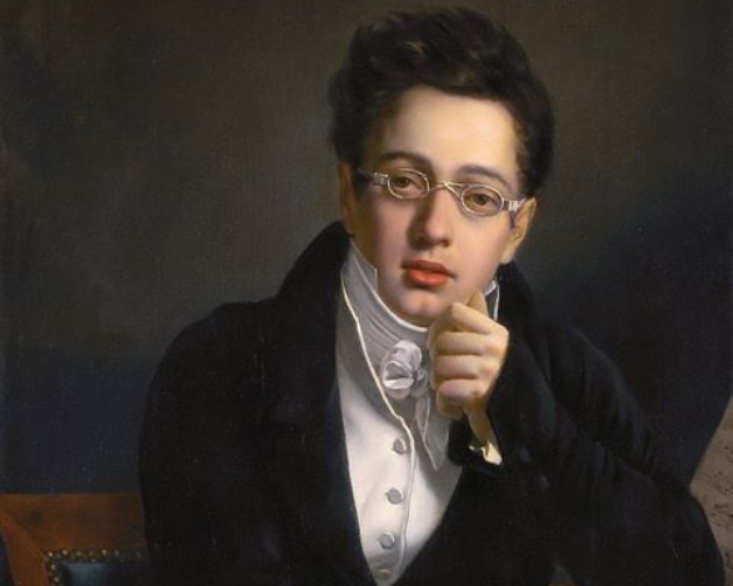
Franz Schubert was an enormously versatile and prolific composer. While he often complained about the difficulty of composition, he also could write with exceptional speed and fluidity, finishing one work and immediately beginning another for hours on end. Despite his tragically short life, his catalog of works is staggering – nearly 1000 compositions, including 9 symphonies, 6 masses, 21 piano sonatas, 15 string quartets, 7 singspiels, 9 operas, a melodrama, the intricate music for the play Rosamunde (which included an overture, incidental music, 3 choruses, and 3 ballets), overtures, chamber music, choral works, and more than 600 song settings.
Schubert was born in a suburb of Vienna, the son of a schoolmaster of some repute and an avid amateur musician who provided Schubert with his first musical instruction. He quickly outstripped this tutelage and was sent to Michael Holzer, music director of the local church at Lichtental, for lessons in voice, organ and theory. At age 9, he auditioned for Antonio Salieri, Kapellmeister at the imperial court, and was accepted into the imperial court choir, although he had to wait two years for a vacancy. The position also included a scholarship to the Stadtkonvikt (City Boarding Seminary), and Schubert developed friendships with several fellow students who later provided important financial and social support for his career.
Schubert joined the school’s orchestra as a violinist, quickly rising to first violin and occasional conductor of the ensemble. The orchestra’s repertoire included Beethoven’s first and second symphonies and some overtures, and Schubert developed an abiding admiration of Beethoven’s music and compositional skills. He began to try his hand at composition and some of his music was rehearsed by the orchestra. Salieri followed his progress with great interest and began to give Schubert private composition instruction. (Salieri had been orphaned at 13, and was taken in by composer Florian Leopold Gassmann, who gave him composition lessons, funded his other education, introduced him to the imperial court in Vienna, and arranged for his debut as an opera composer. Salieri paid his mentor’s kindness forward by providing music instruction gratis to talented students.) Salieri tried to steer Schubert toward opera, which to him meant setting Italian text. Schubert didn’t take much nudging, since he already had a great affinity for vocal music, but he had little interest in setting Italian verse. He had acquired a copy of Johann Rudolph Zumsteeg’s Kleine Lieder und Balladen (Short Songs and Ballads) and become fascinated by Zumsteeg’s settings of German language poetry. He reset some of Zumsteeg’s texts and even suggested a project to reset the entire ouvre in a more modern style. Their artistic differences about the merits of setting German versus Italian poetry became significant enough that Schubert and Salieri parted company eventually in 1817.
Schubert left the
Stadtkonvikt in 1813 and returned home to join in the family business of teaching. He took a year-long course at a teacher training college, passed the qualifying test, and joined his father and brothers at their school. He was put in charge of the youngest children and soon found he had little aptitude or pleasure in teaching. He spent most of his free time composing at a furious rate. Being home, he was able to rejoin the family string quartet (he played viola), and he was eventually able to put together enough musicians to form a small orchestra which rehearsed some of his music. Most significantly, he had the opportunity to have the first public performances of his compositions. In 1814, he was invited to compose a mass for the centenary celebration of the Lichtental parish church. He composed the
Mass in F, a complex and brilliant setting for two sopranos, two tenor, alto and bass soloists, chorus, and a full orchestra of strings, winds, horns, trumpets, trombone, timpani and continuo (cellos, basses and organ). The
Gloria was divided into six sub-movements of varying character. There was a great deal of repetition of text in the longer movements (Gloria and
Credo), with some fugues and polyphonic textures applied. At the premiere, Schubert’s brother Ferdinand played the organ, his old teacher Holzer led the singers, and Salieri is thought to have been in attendance. The
Mass was received enthusiastically, Salieri was delighted, and the
Mass was reprised ten days later at the Church of St. Augustine, the official church of the Viennese court. All in all, it was an impressive debut.
Schubert revised the
Mass in F early in 1815, replacing the
Dona nobis pacem with a more extensive version for a third performance. (The weightier
Dona nobis pacem may have had something to do with Napoleon’s escape from Elba and the prospect of the resumption of war after a brief ten months of peace). Schubert also began work on a
Mass in G, which he completed in just six days. In many ways, it is the polar opposite of the
Mass in F. It is more lightly scored: soprano, tenor and bass soloists, chorus, and an orchestra of strings and organ. The
Gloria and
Credo are presented in a straightforward fashion, without being broken into separate sections or using substantial textual repeats. The solo parts are not separate but rather merge seamlessly with the choral writing. The overall design of the
Mass in G bears some similarity to Beethoven’s 1807
Mass in C. It is not known if Schubert was familiar with the
Mass in C. It had been last publicly performed before Schubert arrived at the
Stadtkonvikt, but it was published in 1812, while he was still a student, and the orchestra might have had a copy. While the two works are conceptual cousins, the
Mass in F, with its wealth of beautiful melodies and occasionally quirky modulatory passages is uniquely Schubert.
The opening
Kyrie has a gentle, almost pastoral feel. Schubert’s characteristic harmonic adventurousness is evident even in this early work. There are unexpected harmonic progressions and some very interesting dissonances encountered on the way to harmonic resolutions. The
Gloria is set in the bright and joyful key of D and opens with a sort of musical misdirection, something he learned from Beethoven. It opens with a Mannheim rocket, a rapidly ascending scale (here D major), a traditional bit of word painting foreshadowing the text
in excelsis (in the highest), and you might expect the
Gloria to immediately to open on the tonic D major chord. But the rocket leads to yet another D major scale, this time in quarter notes, slower but still ascending, and Schubert arranges it such that the choral entrance falls on the seventh tone of the scale, making a cadence, something usually reserved for the ending of a line rather than the beginning. It makes a contrast between the word accent and the musical accent which helps propel the music forward, but it also makes you re-think the role of that opening rocket. As the
Gloria unfolds, you find that that rapid scale motif forms the principal material of the orchestral music, and in that context the opening cadence was actually well-placed, a double deception.
The Credo is perhaps the most interesting movement in the Mass. It opens very softly, again somewhat reminiscent of Beethoven’s Mass in C, but unlike Beethoven’s Credo, the music never swells to that affirmation of belief. Schubert also makes some textual modifications which would appear in his later mass settings as well. He does not set the phrases mentioning the “one, holy catholic and apostolic church” and the “resurrection of the dead,” text that he set in the preceding Mass in F, and if this represents some deep-seated personal conviction, Schubert was silent on that score. In contrast to the songs from that period, Schubert generally resisted tone painting in the Mass, but indulges himself slightly in the Credo. The crucifixus etiam pro nobis text (he was also crucified for us) is set in the darker key of B minor, with long, sustained pitches for the chorus and an ominous, walking bass ostinato in the orchestra. The following et resurrexit tertia die (and he rose on the third day) moves to the brighter D major, with an ascending line in the orchestra. And on the text cujus regni non erit finis (his reign will have no end), the chorus holds a unison C for four measures as the orchestra wends its way to an unexpected resolution in B major.
The Sanctus features another unusual choral opening. The orchestra establishes the D major tonic, but the chorus enters on a very unexpected D7 chord, and the music takes a very idiosyncratic harmonic path to the Osanna. Here Schubert yields to convention and begins the Osanna as a brisk fugue, but breaks off after the first subject to finish with a homophonic statement. The Benedictus, with its long, lyrical vocal lines, is set for solo trio. It concludes with the same truncated Osanna fugue.
The
Agnus Dei may be the most personal of the movements of the
Mass. It begins with slightly agitated music by the strings, somewhat reminiscent of the same movement in the Mozart
Requiem. The soprano and bass soli take turns invoking the
Agnus Dei text, with the chorus quietly adding its assent. The last phrase,
dona nobis pacem (grant us peace) is repeated four times, almost sotto voce. The Austrian empire had been embroiled in the Napoleonic wars for almost the entire time Schubert had been alive. Vienna had been occupied twice by French troops, and his own school had been shelled by the French while he was in attendance. The plea for peace in the face of renewed war following the escape of Napoleon from Elba was sincere and heartfelt.
Schubert had bigger plans for the
Mass in G. In 1818, he added trumpet and timpani parts, and sent the revised score to the important abbey at Klosterneuberg in the hope that the Mass would be performed there. His hope went unrealized and the score languished until 1844, sixteen years after the Schubert’s death, when an otherwise undistinguished Czech composer named Robert Führer obtained a copy of the manuscript and had it published under his own name in Prague. When Schubert’s brother Ferdinand saw the published score, he was furious and engaged in a protracted and often acrimonious negotiation with the publisher to have the score corrected. The score was eventually republished under Schubert’s name, and with additional wind parts written by Ferdinand and clearly indicated as such, and it has become one of Schubert’s most beloved and frequently performed sacred works.
- Michael Moore